One of the most frequently asked questions amongst those who are going through work, legal, or personal responsibility drug screening is the issue of learning how long weed stays in your system (urine test). Regardless of whether cannabis use is infrequent or regular, a lot of factors contribute to detection times. We put the subject matter into a simple and sincere format in this guide, no fear tactics, no medical terms; it is simple, plain, and true information and facts that you can count on.
Marijuana has no residual effects in the body. It is not very similar to alcohol or the majority of other substances, and its active ingredient, THC, does not do its users any service. Instead, the THC is stored in fat cells and it is released slowly over a period. This is the reason why it is appalling to learn that the discovery of weed may still be made long, long after one would have assumed that one would have failed the urine tests, in particular.
This blog explains the definition of THC, the mechanism of its action, the duration in which marijuana can be detected in urine, blood, and hair, as well as the influence of factors on its detection period. We also comment on the myths of common detox, testing facts, and treatment since marijuana use may now be very difficult to control.
Overcome Addiction with Palm Coast Treatment Solutions.
Book an appointment.
Does Weed Stay in Your System?
Yes, weed does remain in your system and this is not a myth but a biological fact. Cannabinol is a fat-soluble compound found in marijuana, and it is referred to as tetrahydrocannabinol (THC). Contrary to soluble compounds in the body that are excreted soon by the urine, THC is stored in fatty body tissues and is released slowly.
Due to this, the duration of your system’s retention of weed will be determined by the frequency of your use, the amount of consumption, and the metabolism levels of your body in terms of fat. In other people, the metabolites of THC can be present for only several days. In other cases, it may take many weeks to be detected.
What is THC?
The main psychoactive substance of marijuana is THC (tetrahydrocannabinol). It works on the same principle by making the brain feel high through the action on the cannabinoid receptors that influence mood, memory, coordination, and perception.
After consumption, whether by smoking, vaping, or by taking edibles, THC is absorbed by the blood, and it diffuses throughout the body. With time, it decays into metabolites, the most common of which is THC-COOH, which most urine drug tests are set to detect.
How Long Does THC Stay in Your System?
There is not a high consistency of incidence of THC between patterns of use and personal biology. General averages include:
- Users who use less frequently (1-2 times a month): 3-7 days.
- Clients (1-4 times weekly): 7-14 days.
- Daily users: 15-30 days
There might be the occasion when the user is called a heavy or long-term user within 30 or more days.
It is not definite commitments; it is merely projections. The body composition, metabolism and lifestyle all have a significant role to play in determining the duration of time that the THC may be present.
How Does Your Body Process THC?
After the THC gets into the system, it is metabolized in the liver to THC-COOH. This is a metabolite that binds to fat cells and slowly discharges back to the bloodstream with time. It gets out of the body after some time in the form of urine and feces.
This gradual excretion is the reason why urine drug tests tend to test positive even many hours after the last use of marijuana. Water temporarily tapers off urine but does not get rid of accumulated THC in the body.
How Long is Marijuana Detectable in Different Tests?
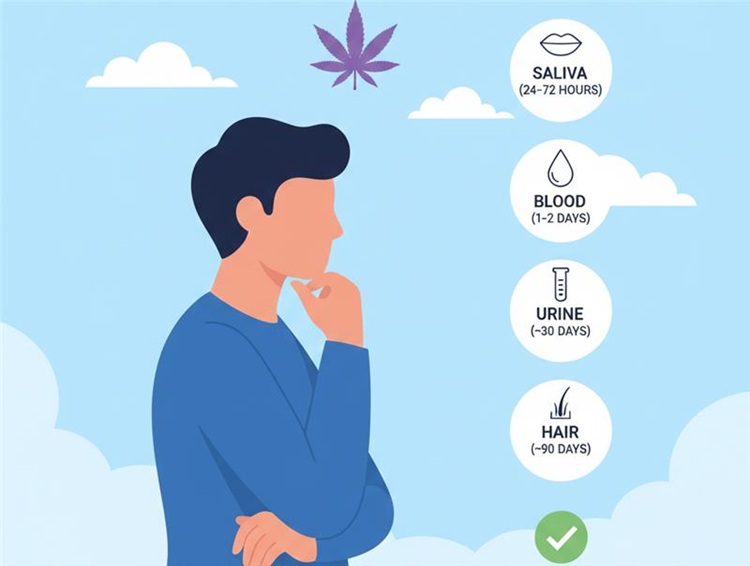
The drug test determines the time of detection. Though the most widespread one is the urine testing, blood, saliva and hair testing may also be used under some circumstances.
One can take advantage of these differences to realize why the politics of marijuana detection can be viewed as a matter of a dice roll.
How Long Does Weed Stay in Your Urine?
The norm of detecting the use of marijuana is said to be the urine tests. They are not the ones that analyze the presence of active THC, but the presence of the THC-COOH metabolites.
Character urine-detect hidden windows are:
- Occasional use: Up to 3 days
- Moderate use: 7–10 days
- Daily use: 10–15 days
- Heavy use: 30 days or more
Urine tests are administered to determine any previous use and lack of current impairment and that is why they tend to create an alarming effect when it comes to individuals who are being screened.
How Long Does Weed Stay in Your Hair?
Hair follicle tests have the longest maximum period of detection. The metabolites of THC are detectable in hair within 90 days. These are not so popular and they can be used in case of a court or in the workplace that is very protective.
Hair samples are not as efficient in determining the recent use; however, they may be utilized to determine the patterns of long-term marijuana exposure.
How Long Does Weed Stay in Your Blood?
Blood tests prove more viable in the determination of recent impairment/use since they measure active THC rather than the metabolites.
- Occasional users: 1–2 days
- Heavy users: Up to 7 days
Though THC is admitted out of blood comparatively quickly, practically, there are opportunities that certain metabolites would be left deposited in other areas of the body.
Detoxing From Weed
Even though this is commonly sold, one cannot say that there is a sure method of washing the THC out of the body overnight. The detox tea, pills, and kits may delay the cleansing of the urine; however fail to get rid of the THCs that are resting on the fat cells.
The only technique that has been proven is time. To avoid becoming stressed and having to live without marijuana or doing the drug tests because of the constant stress, it may be preferable to address the problem with the help of a professional instead of finding the easy way out.

Marijuana Addiction Treatment Near You
Seek help in case marijuana use is impairing your motivation, relationship, mental health, or day-to-day responsibilities. Evidence-based care is provided to the people at Palm Coast Treatment Solutions in a judgment-free setting.
The treatment methods are focused on the disclosure of the causes of use, teaching more productive coping strategies, and the creation of lasting stability. The initial one is to figure out what is happening.
Whenever you ask yourself the question of how long weed remains in your system, you are not alone. Whether it’s a drug test or your health, the right information is important. And when the use of marijuana is already more than a habit, professional assistance can help to make a difference today.
Disclaimer
This content is for informational and educational purposes only and is not intended to replace professional medical, legal, or psychological advice. Drug detection times can vary significantly between individuals. For personalized guidance, consult a qualified healthcare or addiction treatment professional.
Frequently Asked Questions (FAQs)
How long will drugs show up in a urine test?
Most drugs appear in urine for 1–7 days. Marijuana is an exception, as THC metabolites can remain detectable for several weeks, especially in frequent or heavy users.
How long do I need to be clean to pass a urine drug test?
For marijuana, occasional users may pass within a few days, while daily or heavy users may need 2–4 weeks or longer to test negative.
What drugs cannot be detected in urine?
Some substances, including certain inhalants or synthetic drugs, may not show on standard urine panels unless specifically tested for.
How old can pee be for a drug test?
Urine samples must typically be fresh usually within 24 hours and properly stored. Older samples may be rejected due to degradation or contamination.
How long does it take for a urine test to be clear?
A “clear” result depends on the substance used, frequency, and metabolism. For marijuana, clearance may take anywhere from a few days to over a month.
Sources
- Mayo Clinic – Drug testing and detection windows
- National Institute on Drug Abuse (NIDA) – Marijuana drug facts
- Substance Abuse and Mental Health Services Administration (SAMHSA) – Drug testing guidelines
- Journal of Analytical Toxicology – THC metabolism and detection