Quick Answer: Evidence-based practice is an amalgamation of solid research, clinical skill, and personal values. These can be modalities such as CBT, contingency management, motivational interviewing, or medication-assisted treatment.
Key Takeaways
- There are 3 components of evidence-based practice: research, clinician judgement, and what matters to you.
- It is better to state in a named example than to make a less specific promise. There are methods you can check out: CBT and contingency management.
- When a clinic isn’t able to articulate its procedures, it says a lot by itself.
The majority of pages on this subject are geared towards nursing students. Good if you are taking an examination, not so good if you are seeking and choosing a treatment center and you want to know if their treatment works.
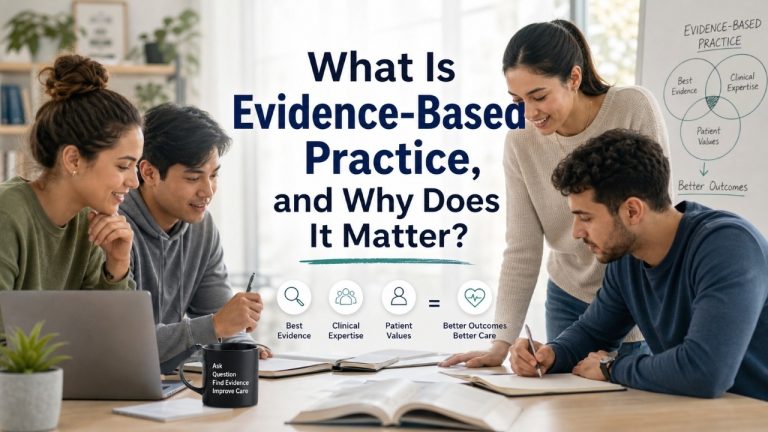
Evidence-based practice requires decision-making at the intersection of three: the best available research, clinicians’ trained judgment, and your values and situation. Some of the most frequently used are handwashing procedures, fall precautions, Contingency Management, medication-assisted treatment, and cognitive behavioral therapy. All are given names, investigated, and measurable.
This page deals with both. You can ask any provider the overall definition and actual examples of behavioral health in action by name.
What is Evidence-Based Practice?
Evidence-based practice is a method of making decisions, rather than one treatment. Before providing care, it poses one question: what does the best available scientific data indicate, and is that appropriate for this individual?
Three elements must exist:
- Best available research. Identify results of a controlled trial or systematic review. Do not rely on custom or tradition.
- Clinical expertise. A professional health care worker decides whether or not the research is relevant to the individual they are treating.
- Patient’s values and circumstances. Who you are and your resources, money, and willingness to do.
Take away any one piece, and it isn’t evidence-based practice. Research, without any application, is simply a going-through-the-motions form of protocol. Practical experience then becomes common sense without a scientific basis.
Call Palm Coast Treatment Solutions and ask how we treat you.
How Does Something Become Evidence-Based?
A method becomes a method upon it having passed testing and not by popular acclaim or by being scientific-sounding.
Usually, the procedure involves five steps:
- A clinical question is asked by someone clear and answerable
- The researchers look for the highest quality existing evidence
- None of the evidence is simply counted but is appraised for quality
- The method is used in real practice
- Good outcome measures are undertaken, and the approach is adapted or abandoned
At the federal level, the entire body of evidence is then considered. The National Institutes of Health states that each agency has its own process, and typically, a systematic review or meta-analysis is performed before designating something as an evidence-based recommendation.
Examples Of Evidence-Based Practice In Healthcare
These are examples that most articles include, and it’s good to know them, as these show the pattern.
Example | What it replaced | Why it is evidence-based |
Hand hygiene protocols | Washing hands when they looked dirty | Measured drops in hospital-acquired infections |
Fall prevention screening | Reacting after a fall happened | Balance checks and vision tests cut fall rates |
Oxygen targets in lung disease | Giving as much oxygen as possible | Trials showed controlled levels work better. |
Smaller gauge IV catheters | Using the largest needle available | Comfort improved without harming the transfusion. |
Aseptic wound dressing | Technique varies by individual nurse | The standardized method lowered infection rates |
With each habit that was tested, it was found to be lacking, and a numeric replacement was found.
Fact: The number of drug overdose deaths in the United States decreased by 26.2 percent from 2023 to 2024.
Evidence-Based Practice Examples in Addiction Treatment
It is the part that most articles neglect. There are methods for addiction care which have been named and tested.
Method | What happens in practice? | Best suited to |
Cognitive behavioral therapy | Spot triggers, build coping responses, and practice them. | Most substance use disorders |
Contingency management | Small rewards for verified abstinence or attendance | Stimulant use, treatment retention |
Motivational interviewing | Work through ambivalence instead of arguing against it | People unsure about changing |
Motivational enhancement therapy | Short structured sessions building personal reasons to change | Early stage engagement |
The Matrix Model | Intensive outpatient mixing counseling, skills and family education | Stimulant use disorder |
Twelve-step facilitation | Structured work linking you into peer support | People who want a fellowship structure |
Medication-assisted treatment | Buprenorphine, methadone, or naltrexone alongside counseling | Opioid and alcohol use disorder |
NIDA acknowledges contingency management as an evidence-based treatment method for several substance use disorders, and research has shown the method to be associated with increased abstinence and treatment engagement.
All of these are featured in federally released reviews of effective addiction treatment. Feel free to do some research on any of them prior to your initial appointment.
Be sure to check your coverage with Palm Coast Treatment Solutions
Examples Of Evidence-Based Practice In Mental Health
The same is true for mental health care, albeit with different methods that are named.
- Cognitive behavioral therapy: challenges thinking that is associated with anxiety or depression against evidence
- Dialectical behavior therapy: focuses on developing skills for severe emotions and unstable relationships
- Acceptance and commitment therapy: decreases struggle with challenging thoughts
- Exposure therapy: confronts situations systematically in a gradual manner
- Trauma-focused approaches: process trauma memories that still impinge upon daily life
- Family therapy: considers the whole family system, not just one individual
All have research bases that you can look at. None of them are a brand name that is invented by a single clinic.
What Evidence-Based Practice Is Not
Unfortunately, it’s a term that is tossed around in marketing, so it’s best to understand what is not included.
- “Research-backed” with no method specified. Named means checkable, and if it isn’t named, it can’t be checked.
- A signature program of only one clinic. Only a method that is offered by one place has not been independently tested.
- Testimonials rather than results. Stories are not data, no matter how moving they can be.
- Tradition. “We have always done it this way” is contrary to evidence-based practice.
- A single study. One successful experiment is the beginning, not the end.
The National Institutes of Health identifies registries that present federal agencies’ list of reviewed programs since no single clinic can decide what is evidence-based.
How to Assess That Your Care Is Evidence-Based
It is OK to ask. A good provider goes into their job with the understanding that these questions will be posed and can respond in plain terms.
Here are questions to ask before you commit:
- What are the specific methods you use, and what are they called?
- What is the research used for my scenario?
- How will you measure to demonstrate that this is effective?
- About review, how will it be done and how often?
- If this doesn’t help me, what do you do?
If the clinic responds by brand name and not by method names, it’s time to look for another clinic. So is one that can’t say how progress gets measured.
Expert Advice: Gather your provider’s name for the method and measure, not branding.
Why Evidence-Based Practice Is Important In Recovery
It’s the disconnect that lies between what’s effective and what individuals actually get in addiction treatment that is the problem.
A lot of individuals try out programs one after the other, which have not been tried. Others take effective but unmeasured treatments, and no attention is paid to the reactions when the treatment is ineffective. Evidence-based practice fills both voids.
What the data shows | The figure | Source and year |
US drug overdose deaths, 2023 | 105,007 | CDC National Center for Health Statistics, 2026 |
US drug overdose deaths, 2024 | 79,384 | CDC National Center for Health Statistics, 2026 |
Fall in the overdose death rate | 26.2 percent, the largest since 2014 | CDC National Center for Health Statistics, 2026 |
US adults who got counseling or therapy in a year | 14.0 percent | CDC, 2024 survey |
US adults who took mental health medicine | 19.3 percent | CDC, 2024 survey |
The overdose dip is the most obvious recent evidence for the need for evidence-based practice. Researchers cite several reasons, such as being able to stock naloxone more widely and medication-assisted treatment.
Evidence-Based Practice and Co-Occurring Conditions
Treating addiction while neglecting a mental health disorder is not usually successful, and the research on this is detailed.
Integrated care is a one-team approach to both with one plan. The other option, switching people back and forth between two services that don’t communicate with each other, typically results in both services blaming the other condition for the relapse.
Federal assessments of addiction treatment consistently reveal that people with co-occurring mental health disorders do better when the two treatments are given simultaneously rather than consecutively.

Evidence-Based Practice at Palm Coast Treatment Solutions
All the above is checkable, and that’s the point. Here are the products used by Palm Coast Treatment Solutions and what they call them so that you can research them.
Therapies used here:
- Cognitive behavioral therapy, for triggers and coping skills
- Dialectical behavior therapy, for intense emotions
- Acceptance and commitment therapy, for avoiding and worrying
- Trauma therapy, for shaping day-to-day life experiences
- Relapse prevention therapy for the stretch after stabilizing
- Family and group therapy, as well as individual therapy
- Holistic therapy and management plan for medications as applicable
How much would you go?
- Partial hospitalization program, most of the day for several days a week
- Intensive outpatient, several sessions a week while staying home
- Outpatient, decreased sessions with return to independence
- Aftercare, to maintain gains post-treatment
Here, care is outpatient, meaning that you continue to live at home and go to work while going for care. Our dual diagnosis program provides an integrated approach to tackling substance use and mental health while preventing the service from turning the baton over to other services.
In all our centers, we treat opioid and alcohol use disorder with medication-assisted treatment. Enquire about what types of medication-assisted treatment are available to you.
Our staff is located in Palm Coast, Florida. Give us a call at (386) 284-4151 or use our contact page so we can discuss with you what would work best for you.
FAQs
What are the three parts fundamental to the practice of evidence-based practice?
Evidence-based practice consists of best research, clinical experience, and patient values. All three must occur simultaneously. Research by itself, without using it in a judgmental way, turns into a ‘one size fits all’ approach, clinical experience alone throws out a plan without giving it a second thought, which becomes guesswork, and everything is undertaken without considering the patient’s wishes, which means that within weeks people abandon the plans that were thrown out in their direction.
Differentiate between evidence-based practice and research.
Research is the process of testing a question in a controlled environment and the creation of new knowledge. Evidence-based practice uses that knowledge in relation to a particular patient based on clinical judgement and the desires of the patient. Research asks what works in general, and practice asks what works for this person now.
What’s the most popular example of evidence-based practice?
Probably the most typical instructing example is the handwashing procedure in a hospital, where the information concerning the before-and-after infection data is evident and simple to adhere to. Cognitive behavioral therapy is the most famous in behavioral health, and has a long history of controlled trials.
How to identify if a treatment center applies evidence-based practice?
Have them say their ways aloud. It should sound like cognitive behavioral therapy, not a named program that you can’t learn about on the internet. Next, ask about what and how progress is measured and who reviews the progress of a plan.
Is contingency management actually evidence-based?
Yes. It provides very small incentives for demonstrated abstinence or session attendance and is effective in several substance use disorders, most notably stimulant use, as per federal reviews. It also enhances retention in treatment, which is important in itself, as an early exit is a predictor of relapse.
Identify the 5 steps of evidence-based practice.
Formulate a clear clinical question, find the best available evidence, appraise the evidence instead of simply counting the number of studies, implement the evidence, and then assess the results. It’s the last step that’s most commonly neglected, and when left undone, no one ever hears about when something quietly goes down.
Does “evidence-based” mean it will work for you?
No. It is a technique that has been proven to be effective for a sufficient number of people in controlled trials to be used first. In fact, response rates are rarely 100 percent, and normally,t a first approach may not help you. It’s not a sign that it’s impossible to help you.
Can medication be a component of evidence-based practice?
Yes. Medication-assisted treatment is using medication like buprenorphine, methadone, or naltrexone along with continued counseling and is one of the most researched addiction treatment solutions today. It’s not a last resort if all else fails, but is a first-line option for opioid use disorder.
What are the evidence-based practices for co-occurring disorders?
Integrated treatment where one team provides mental health and substance use treatment simultaneously with CBT, DBT, medication management, and family work. If you try to treat them in isolation or one after the other, you will get inferior results than treating them concurrently.
Where can I find evidence-based programs?
Public registries of programs reviewed by federal agencies and the National Institutes of Health provide links to some of them in a single place. Before your first appointment, you can see the conclusions of the systematic reviews on a method that you are interested in searching by its name.
References
- https://prevention.nih.gov/research-priorities/dissemination-implementation/evidence-based-practices-programs
- https://www.cdc.gov/nchs/data/databriefs/db549.pdf
- https://www.cdc.gov/nchs/products/databriefs/db564.htm
- https://nida.nih.gov/publications/principles-drug-addiction-treatment-research-based-guide-third-edition
- https://nida.nih.gov/publications/research-reports/common-comorbidities-substance-use-disorders
- https://www.nimh.nih.gov/health/topics/psychotherapies
- https://pmc.ncbi.nlm.nih.gov/articles/PMC8475916/
- https://www.ruralhealthinfo.org/toolkits/substance-use/2/treatment/behavioral-therapy
- https://www.who.int/news-room/fact-sheets/detail/mental-disorders