The issue of the time it takes cocaine to turn a negative is a well-known cause of concern among the people who are in the initial stages of recovery or those who have just entered specialist recovery setting. Cocaine is a strong stimulant whose high is so brief, yet the chemical trace remains in the body much longer than the feeling of euphoria. To comprehend the switch to negative test result, it is necessary to consider a parent drug and its metabolic products, which are benzoylecgonine in the first place. These metabolites act as a biological history of recent drug consumption, they remain present even when the person feels totally sober.
Drug screening objectives are not punitive in a structured care setting; on the contrary, it is a crucial clinical measure of physiological stabilization and safety in a structured care setting. A negative result does not have a fixed number as a timeline but a range based on a complicated set of biological factors and usage habits. To manage this window of detection, one is supposed to have knowledge on how the body processes toxins.
Expert Advice: Metabolism of cocaine is very fast and the metabolites are expelled slowly through the kidneys over the period of several days or weeks.
Understanding Cocaine Metabolism
Once the cocaine gets into the system, it quickly gets into the blood and spreads to the brain and other organs. The liver and plasma enzymes instantly start to decompose it into small and inactive substances. The most important of them is the benzoylecgonine and then the ecgonine methyl ester. Due to the rapid disappearance of the parent drug, normal screenings are specifically adjusted to pick up these metabolites, which gives them a far broader volume of time to be recognized.
These clearance rates are observed in a treatment environment by professionals to determine how strongly the environment has been utilized. With the system, a negative urine test is achieved by most occasional users in a few days. This is however much more protracted in cases of chronic use. This metabolic schedule emphasizes the need of professional supervision, since the existence of such chemicals may influence sleep, mood, and heart rate at the initial stages of professional supervision.
Detection Windows by Testing Method
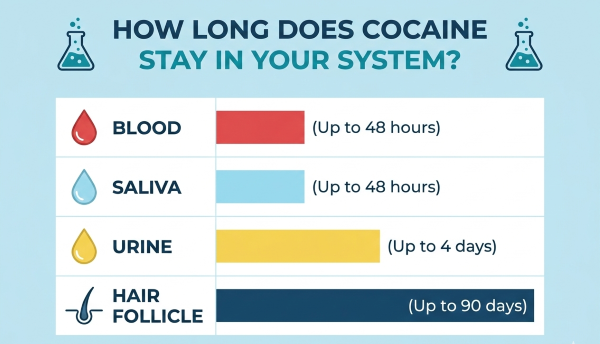
The various biological specimens have different time windows during which the use of cocaine can be detected. The table below gives the common schedules adopted in a recovery services framework.
Test Type | Typical Detection Window | Primary Use Case |
Blood Test | 12 to 48 Hours | Acute intoxication / Emergency care |
Saliva Test | 1 to 2 Days | Recent use / Non-invasive screening |
Urine Test | 2 to 4 Days (Single Use) | Routine monitoring / Workplace testing |
Hair Follicle | Up to 90 Days | Long-term history / Patterns of use |
If you have questions about structured care, contact Palm Coast Treatment Solutions
Factors Influencing How Long Cocaine Stays in Your System
- Frequency and Duration of Use: Chronic or intensive use results in the metabolites remaining in the body tissues, i.e. the system takes longer to eliminate the metabolites than in the case of single use. A history of heavy use is usually detected to have a history of up to two weeks of history in a monitored setting or even beyond in urine samples.
- Metabolic and Organ Health: The liver plays the greatest role in degrading materials although the excretion is done through kidneys. Any damage to these organs may considerably decelerate the process of clearance. The personal aspects, which include age, body mass index (BMI), and the level of hydration are also important determinants of the speed at which one will test negative.
The Science of “Cocaethylene”
There is a special problem of taking cocaine with alcohol. A third metabolite, cocaethylene, is produced in the liver. It is much more toxic than pure cocaine and its half-life is much higher. Since it stays longer in the system, it makes the system more vulnerable to cardiovascular stress and the occurrence of heart complications. When it comes to a recovery services setting, detecting the presence of cocaethylene is critical in the area of ensuring the safety of the person in the stabilization process.
This is a major cause of why this is known as a cocaine cocktail effect that is why they should be under professional supervision when clearing a number of substances. The occurrence of cocaethylene may lengthen the limits of detection and increase the psychological suffering during the withdrawal. In a systematic care setting, these risks are controllable since the clinicians are able to offer the required medical and emotional levels of supervised care to mitigate these risks.
FACT: Cocaine has a biological half-life of approximately one hour, yet its primary metabolite, benzoylecgonine, has a half-life of roughly six to twelve hours.
Comparing Clearance in Occasional vs. Chronic Users
Usage patterns dictate the speed at which the body achieves a negative status. The table below illustrates these differences as observed in a professional recovery environment.
Usage Level | Urine Detection Time | Physiological Implication |
Single Use | 2 to 3 Days | Rapid clearance; low tissue accumulation |
Moderate Use | 3 to 7 Days | Gradual buildup of benzoylecgonine |
Chronic/Heavy Use | 10 to 14+ Days | Significant tissue saturation; slower detox |
Polydrug (with Alcohol) | Extended Windows | Higher toxicity; increased cardiac risk |
Palm Coast Treatment Solutions offers information on recovery services
Why a Monitored Setting is Vital for Negative Testing
Waiting to get a drug test to come negative is usually a period of anxiety and physical distress. Under a monitored setting, the individuals are taken out of the environmental stimuli that may provoke a relapse to use within this stressful period. The treatment environment offers a digital and social detox which enables the brain and the body to re-set without the constant presence of substances.
Moreover, professional supervision guarantees that the withdrawal process that may involve fatigue, depression and strong cravings is handled without cruelty. Monitoring and therapeutic help during this period involves the medical observation and assistance in making the subject realize that it is but a start in a considerably bigger process of healing. This systematic endeavor is what offers stability to ensure that the negative outcome is there to stay.
Developing a Sustainable Path Forward
The negative test result is a big milestone but not the milestone of the recovery process. As soon as the toxins are eliminated, the actual effort of working on the reasons behind the use kicks off. A professional recovery environment involves the transfer of individuals out of physical stabilization and into emotional and behavioral development. These include acquiring new coping skills, recovery of the relationship, and purpose without stimulants.
The tools necessary to continue to rely on wellness are also offered through recovery services that are required once the detection windows have been closed. Through meeting a community of support and applying evidence-based therapies, people will be able to turn a short-lived status of cleanliness into a lifetime commitment to health. The professional supervision during this transition will make sure that all the steps are supported by clinical knowledge and peer support.

Resilience Through Structured Care
Palm Coast Treatment Solutions is a professional team in which patients are able to concentrate on their recovery process. Our services attach the significance of a monitored environment so that each individual is provided with the necessary degree of controlled assistance in accordance with their exclusive conditions. With the option of a structured approach, you are refusing the basis of safety and professional supervision that gives rise to a more stable and healthy lifestyle.
Medical Disclaimer: This blog is for informational purposes only and is not a substitute for professional medical advice.
Key Takeaways
- Cocaine metabolites, not the drug itself, are the primary targets of most drug screenings.
- Urine tests typically detect use for 3 to 5 days, though this is longer for chronic users.
- The liver produces cocaethylene when alcohol is present, which is more toxic and lasts longer.
- Organ health, body mass, and hydration all influence how quickly the body clears metabolites.
- Hair follicle tests provide the longest window of detection, spanning up to 90 days.
- A monitored setting ensures safety and provides emotional support during the clearance phase.
FAQs
How long will cocaine show up in a standard urine test?
For occasional users, cocaine metabolites are generally detectable for 2 to 4 days. However, in a professional recovery environment, it is noted that chronic or heavy users may test positive for up to 14 days or longer. Professional oversight helps track this clearance to monitor your physiological progress.
Can I do anything to make cocaine leave my system faster?
While drinking water and staying healthy can support your organs, there is no reliable way to “flush” metabolites out instantly. Your liver and kidneys require a set amount of time to process these chemicals. Supervised support focuses on ensuring your body functions optimally during this natural metabolic window.
Why does a hair test go back so much further than others?
Metabolites enter the hair follicle through the bloodstream and become trapped in the hair shaft as it grows. Because hair grows at a predictable rate, a 1.5-inch sample provides a 90-day history. This method is often used in a monitored setting to assess long-term behavioral patterns and recovery.
Will a negative test mean the cocaine is completely gone?
A negative test means the level of metabolites has fallen below a specific “cutoff” concentration. While it indicates the body has cleared most of the substance, a monitored setting focuses on the fact that neurological recovery continues long after the chemicals are no longer detectable by a standard drug screening.
Does using alcohol really change how long cocaine stays in the body?
Yes, consuming alcohol with cocaine creates cocaethylene, a metabolite that takes much longer to clear. In a structured care environment, clinicians monitor for this because it significantly increases heart risks. This toxic byproduct can extend detection times and requires specific professional oversight to ensure a safe and healthy detoxification.
References
- The Recovery Village
- Substance Abuse and Mental Health Services Administration (SAMHSA)
- Mayo Clinic Laboratories
- Journal of Analytical Toxicology
- PubMed Central (PMC)