In This Blog
- Learn the purpose of equine therapy and how it promotes emotional and mental growth.
- Understand why equine-assisted therapy is effective and how it helps with trauma, anxiety, and personal development.
- Explore common uses, benefits, and key techniques, from grooming to obstacle courses.
- Discover a table of essential skills developed through equine therapy, including empathy, confidence, and mindfulness.
- Get expert advice, safety tips, and research-backed insights to support meaningful progress and real-life applications of equine therapy.
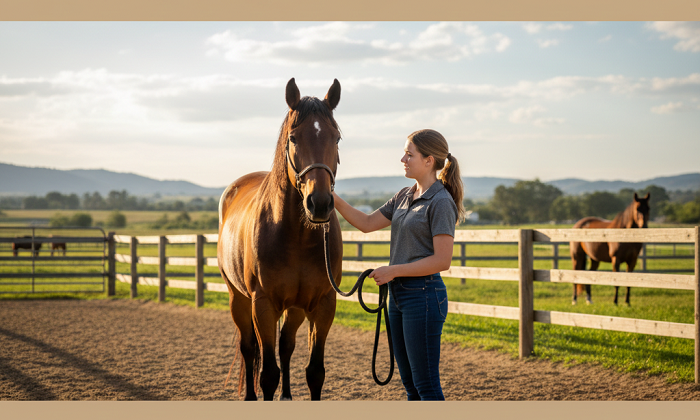
Equine therapy, or equine-assisted therapy, is a therapeutic process that uses facilitated contact with horses to aid in emotional, mental, and behavioral health. It is also experiential learning; as contrasted to the traditional talk therapy, the learners are exposed to grooming, leading, and watching horses to learn how they feel and behave.
Equine therapy is intended to strengthen personal growth, emotional management, and confidence. It is used on children with developmental problems, adults who have experienced a traumatic event, and professionals with PTSD.
Equine-assisted therapy provides an environment that is very safe and conducive, whereby the client can cope with their feelings, learn coping mechanisms, and have a breakthrough, which is hard to achieve in traditional therapy through a combination of direct work guided by the professional.
Why is Equine Therapy Effective?
The equine therapy is rather effective, as horses are attentive to the emotions of human beings.
They are emotional and may seize the emotion of the participants and deliver the real-time feedback to them without using verbal communication.
This reflection makes the clients conscious of their feelings, which they may not realize.
Some of its reasons for high effectiveness include:
- Emotional Mirroring: The horses react to the stress rates, fear, or lack of it and assist the participants in being conscious and focusing on the emotions safely.
- Non-Evaluative Space: The participants are not pressured, and they are made to be open and honest.
- Trust and Empathy: Having learned how to associate with a horse, one gets to know more about the other person and learns his/her talents.
- Mindfulness and Presence: This means that to deal with horses, one has to use the concentration of body language and energy that will enable one to be more aware of being stress-free.
Physiologically, the studies have shown that equine-assisted therapy will reduce the speed of heart rate and cortisol, which will help to control emotions. The lessons learned also become better as a result of the interactive nature of the therapy, and the skills are applicable in real life.
It could be therapy for traumas, relaxation, or assistance in development; equine therapy provides a therapeutic environment of responsiveness, which enhances growth and rate of emotional healing.
What is Equine Therapy Used For?
Equine therapy is extensively used regardless of age and condition:
- Trauma Recovery: Assists people in coping with previous experiences in a safe way.
- PTSD Support: Receive well-organized contacts in an environment that is not threatening.
- Autism Spectrum Disorders: CT is more focused, sociable and obedient to routine.
- Anxiety & Depression: Relaxes, takes away stress, and plays with horses.
- Recovery from Addiction: Favors responsibility and accountability and the acquisition of coping methods.
Therapists structure the therapies in such a way that they meet some goals. Taking the example of the obstacle courses, one can learn to solve the problems and grooming activities to learn patience and empathy. These activities lead to the real-world application of emotion regulation, social skills, and confidence.
Key Skills Developed Through Equine Therapy
Skill | How Therapy Develops It | Real-Life Benefit |
Self-Regulation | Horses respond to participants’ energy | Manage stress and emotions better |
Empathy | Caring for horses teaches awareness of needs | Improve relationships and understanding |
Decision-Making | Obstacle tasks encourage strategic thinking | Make confident choices under pressure |
Responsibility | Grooming and care reinforce accountability | Build reliability and trustworthiness |
Confidence | Handling a large animal boosts self-belief | Increase self-esteem |
Social Awareness | Group sessions foster teamwork | Better collaboration and communication |
Mindfulness | Horses require focus and presence | Stay present and reduce anxiety |
100% Confidential Support is Available 24/7
No matter what you’re going through, you’re not alone. Our dedicated team is here to provide a safe, judgment-free space where you can talk openly and honestly. Whether you need emotional support, resources, or just someone to listen.
We’re here for you—completely confidential and always respectful of your privacy. Call us today!
What is Equine Therapy Good For?
The equine therapy will likely enable numerous skills, as it will help people become more self-confident and aware and learn how to respond to their daily lives in a better way:
- Emotional Awareness: How to train a horse to learn and manage emotions.
- Confidence Building: This will create self-esteem since the skill of handling horses will be trained.
- Relaxation: Release of stress based on grooming and playing with horses.
- Normalization of social functioning: Preferences and cooperation, and sympathy.
- Behavioral: Assists in being patient, responsible, and problem-solving.
- Mindfulness: Horses cannot be left unattended, and as such, the participants can be available.
The majority of the clients have asserted that their emotional composure, stress, and strength have improved. They have a chance to experiment and learn to cope with the help of equine therapy, as well as learn transferable skills for real life, because the space these people are given is both structured and emotionally safe.
Expert’s Advice – Build trust gradually, stay patient, and observe the horse to learn about yourself.
FACT: A 2023 NIH study found 68% saw reduced PTSD and anxiety after equine therapy.
Contact Palm Coast Treatment Solutions
Battling with Drug and Alcohol Addition? Remember, you are not alone and we are here to help you!
Equine Therapy Techniques
Some techniques are applied by the therapists to fulfill personal goals:
- Care & Grooming: Instruction on responsibility, patience, and compassion.
- Headquarters and Groundwork: Improves communication and attention and builds trust.
- Obstacle Courses: Learn to be a problem solver and self-controlled planner.
- Mounted Activities: Improves confidence, balance, and coordination.
- Reflection & Observation: The participants find the behavior of horses as a method of experiencing the sensation of their emotions.
- Role-Play Exercises: Training in social skills, conflict resolution, and teamwork.
The lessons will be designed according to the needs of the participants and the nature of the horse. The practicality of the tasks can make the event significant, secure, and worthwhile, and this can be reflected.
Overcome Addiction with Palm Coast Treatment Solutions.
Book an appointment.
Special Applications of Equine Therapy
According to an evidence-based practice, equine-assisted therapy has some outcomes in the event of certain disorders:
- Post-Traumatic Stress Disorder (PTSD): Horses do not appear as harmful as the conventional treatment, and a person can easily restore his/her trust.
- Autism Spectrum Disorder: Horses allow the focus, routine, and exchange and contribute to a child’s accrual.
- Addiction Recovery: EAT helps in accountability and responsibility, which are among the competencies required in a long-term recovery process.
- Depression and Anxiety: The company of horses will help people to be less lonely and raise the level of serotonin.
The equine-assisted therapy can be a great addition to the regular therapeutic methods and is worthy of being planned, though it should not replace the traditional methods of therapy; fine-tuning activities and needs to suit the particular conditions is necessary.
Key Takeaways
Equine therapy helps in developing emotions, mind, and behavior.
- Horses are self-reflective and provide instant feedback, which is used in self-understanding.
- Depression, post-traumatic stress disorder, trauma, and addiction.
- These advantages are confidence, emotional control, stress reduction, and social skills.
- Some of the ways through which learning is facilitated are grooming, leading, obstacle courses and reflection.
- Offers a holistic and safe environment of whole-person development.
- Develop health in the future by improving the modalities of the healing tradition.
FAQs
What is the goal of equine therapy?
The equine therapy is geared towards emotional, behavioral, and social skill enhancement through mediated interaction with the horses. The learner learns to cope with pressures and emotions and develop self-awareness and confidence, empathy and other coping skills through a safe, mediate,d and experience-based approach to the traditional therapies.
What are the activities of equine therapy?
These are grooming, leading horses, obstacle courses, and ground work. The participants can also use the mounted exercises, role-play, or reflection observation. Depending on the personal skill and intentions, the activities are arranged in a way that would enable an individual to better his or her emotional control, problem-solving, social skills, patience, and confidence.
What to expect with equine therapy?
The participants will get a chance to look forward to the planned sessions involving a trained therapist and a therapy horse. The actions are guided to experience, observation and reflection. The sessions are not intimidating; they are enabling and concentrate on and assist an individual to develop emotional awareness, faith, trust, and social abilities, not to mention learning the strengths of coping strategies in actual life.
What are the principles of equine therapy?
The most important of them are trust-building, empathy, emotional mirroring, non-judgmental interaction and experiential learning. Treatment is a burden on mindfulness, responsibility, patience and reflective observation. The horses provide immediate feedback to the participants according to their behaviors and emotions.
Who benefits the most from equine therapy?
It benefits most the depression, PTSD, anxiety, and trauma victims, who were involved in the autism spectrum disorders and behavioral issues the most. It is assumed that the emotional regulation, confidence, social skills, and coping strategies are expected to be enhanced in children and adults. The treatment can be applied as well in the case of people requiring personal development or experiencing stress or interpersonal skills decline.
How much does a horse therapy session cost?
The charges will rely on the level of location, experience of the therapist, time of the session, and the program. The average per hour in sessions ranges between 75 and 150 dollars. Other programs can include packages, sliding scales, or insurance. The respondents will be asked to approach providers to obtain part of the costs and explore possible financial possibilities.