In This Blog
- Defining Hydrocodone and Its Uses
- How the Substance Affects the Body
- Commonly Observed Side Effects
- Identifying Signs of Misuse
- Navigating the Path to Recovery
Hydrocodone is a semi-synthetic opioid derived as a derivative of codeine and is mainly used in a professional recovery facility to treat severe physical pain. It is commonly developed in combination with non-opioid drugs, including acetaminophen or ibuprofen, to make its effect more powerful. Being a central nervous system depression, it acts by changing the perception and response to pain signals by the brain.
Although it has a particular function in the context of structured care facilities, the fact that it is a Schedule II controlled substance points at its high levels of the risk of physical dependence and misuse. The initial move towards establishing the impact of this substance on long-term wellness is understanding the mechanism of the substance. Understanding of its physiological effect enables the affected person and his/her support groups to make a wise decision concerning its use and the need to have a monitored environment.
Expert Advice: Hydrocodone should be closely monitored by a professional in order to reduce the chances of physical dependency.
Defining Hydrocodone and Its Use Cases
Hydrocodone is mostly used in cases where non-opioid options have failed. Due to its strength, it is common after major physical changes or when a patient is of a chronic condition, which needs a more intensified measure. The aim in such situations is to bring about the comfort level of the individual in order to be able to contribute more in their day to day life.
In a supervised environment, the intake of this drug is strictly adjusted. Professionals evaluate the medical history and the present health condition of the person in order to decide on the most proper dosage. This is a systematic procedure in that the substance does not merely cover the pain, it engages with the opioid receptors within the brain and the spinal cord, producing a systemic effect, which has to be reviewed regularly.
Understanding Administration Formulations
The process of hydrocodone production has an effect on the rate of absorption and the sustained effect. The table given below lists some typical formulations used in a treatment setting.
Formulation Type | Common Co-Ingredients | Primary Purpose |
Immediate-Release | Acetaminophen, Ibuprofen | Acute pain management |
Extended-Release | Pure Hydrocodone | Chronic, long-term discomfort |
Liquid/Syrup | Homatropine | Antitussive (cough suppression) |
In case of any questions regarding structured care, call Palm Coast Treatment Solutions.
100% Confidential Support is Available 24/7
No matter what you’re going through, you’re not alone. Our dedicated team is here to provide a safe, judgment-free space where you can talk openly and honestly. Whether you need emotional support, resources, or just someone to listen.
We’re here for you—completely confidential and always respectful of your privacy. Call us today!
How Hydrocodone Interacts with the Brain
When the substance comes into the blood, it goes to the brain and binds with certain proteins known as mu-opioid receptors. This communication affects a secretion of dopamine, but at the same time, prevents the pain message that the body communicates. This two-fold effect is both soothing and generates a feeling of comfort which the brain might eventually get addicted to through time, resulting in the occurrence of a tolerance.
The tolerance can lead to the fact that the brain will produce less dopamine and cope with unease on its own. This neurochemical change is the reason why supervised support is so essential. The addiction to the substance may shift to a means of obtaining comfort to a source of the behavior without the involvement of a professional, leading to the emergence of an additional obstacle in the process of recovery.
FACT: Studies have shown that opioid receptors have a major role in pain response in the body.
Contact Palm Coast Treatment Solutions
Battling with Drug and Alcohol Addition? Remember, you are not alone and we are here to help you!
Recognizing Common Side Effects
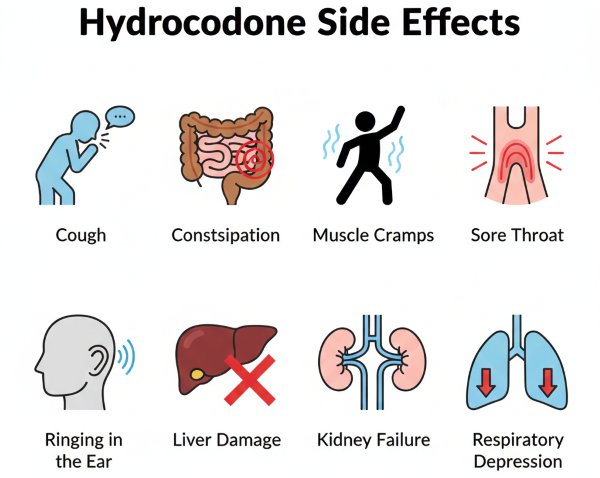
Hydrocodone has a variety of side effects even when administered in a regulated support system. The reactions differ depending on the physiology of a particular person, dosage, and the period of use. It is necessary to recognize such signs in time, which would ensure the preservation of safety and the change of the approach to care when necessary.
Physical side effects tend to be less in the respiratory systems and the digestive system. Since opioids reduce involuntary activities, a person might have a considerable alteration in the rate of metabolism. Observing these symptoms at work will mean that any of these negative responses are dealt with in time before they become more serious health issues.
Gastrointestinal and Physical Symptoms
- Gastrointestinal: General. Denies any vomiting, nausea, or abdominal pain.
- Nausea and Vertigo: A lot of people complain that they feel lightheaded or they have stomach upsets and mostly at the first phases of use.
- Drowsiness: The substance is a sedative and thus may cause severe lethargy or the inability to concentrate.
- Skin Irritation: Itchiness or redness may be observed as the result of the histamine reaction to the presence of the opioid in the system.
Overcome Addiction with Palm Coast Treatment Solutions.
Book an appointment.
Psychological and Behavioral Side Effects
In addition to the physical, hydrocodone affects mood and cognitive functioning. Such changes may not be noticeable initially, but they can manifest themselves in the form of an overall detachment or a change in sleeping habits. In a recovery services setting, it is one of the behavioral changes that can be noticed as a significant part of the process of getting the individual on the correct path to well-being.
In prolonged consumption, there are possibilities of emotional blunting or heightened anxiety as the substance is used. These ups and downs can be directly attributed to an effort by the brain to restore neurochemistry. The professional control can assist people to overcome these emotional waves and give them a stable environment and tools to control their emotions without the use of chemicals.
At Palm Coast Treatment Solutions, you will find information regarding recovery services and all require information
Signs of Misuse and Physical Dependence
It is an important ability to be able to differentiate the proper usage and the development of misuse by those working in a treatment environment. The misuse usually starts when one takes the substance other than prescribed like increasing the dose or other means of getting the substance illegally. This habit is usually because of a physical dependency which has not been treated.
Physical dependence is when the body got used to the presence of the substance, and it needs it to work regularly. In the event of a sudden removal of the substance, the person can end up being withdrawn. This is the reason why a monitored environment is necessary; this will enable the substance to be discontinued gradually and safely and deal with the physiological process of stress linked to cessation.
Category of Sign | Physical Indicators | Behavioral Indicators |
Early Stages | Pinpoint pupils, slurred speech | Social withdrawal, lethargy |
Escalation | Frequent flu-like symptoms | Neglecting responsibilities, secrecy |
Advanced | Respiratory depression, bradycardia | Financial instability, seeking multiple providers |
Overcome Addiction with Palm Coast Treatment Solutions.
Book an appointment.
Navigating Withdrawal in a Monitored Setting
The cycle of getting rid of the hydrocodone may be painful and in severe cases, physically demanding. In a guarded environment, safety and reduced distress are of concern. Evidence-based practices are applied by professionals to cope with the symptoms of muscle aches, insomnia, and extreme cravings. Such a degree of control minimizes the possibility of a re-use at the most vulnerable points of the process.
This stage also includes structured support, which is the monitoring of vital signs and proper hydration and nutrition. The aim is to stabilize the body to ensure that such individuals can eventually undertake the more vigorous stages of recovery services. This is one of the primary stages, although one should keep in mind that it is just the first step in a significantly bigger process of becoming healthier.
Contact Palm Coast Treatment Solutions
Battling with Drug and Alcohol Addition? Remember, you are not alone and we are here to help you!
Long-Term Health and Wellness Strategies
Maintaining wellness once taking hydrocodone means the dedication of a holistic life. This may involve the creation of new habits that focus on physical exercise, nutritious eating, and healthy relationships with others. A recovery services setting would have one explore something that has a natural feeling of achievement and happiness and can thus reprogram the reward system in the brain.
The second important element is the relapse prevention plan development. This plan also determines the possible obstacles and provides certain steps to be made in case the obstacles are encountered. A clear roadmap gives one the feeling of agency and confidence that keeps them on course and helps them to manage the terrors of everyday life.
Comparison of Care Settings
The decision of the environment to choose in recovery is a major one. The table below brings out the disparity between unsupported efforts and professional supervision.
Aspects of Care | Independent Attempt | Structured Support Environment |
Safety Monitoring | Low to None | High; 24-hour professional oversight |
Symptom Management | Unmanaged discomfort | Evidence-informed protocols |
Risk of Return to Use | Significantly higher | Managed through professional intervention |
Continuity of Care | Limited | Comprehensive long-term planning |
Overcome Addiction with Palm Coast Treatment Solutions.
Book an appointment.
Understanding the Risks of Long-Term Opioid Use
Even professional supervision of prolonged exposure to hydrocodone has internal risks to different organ systems. In the long run, the body can undergo a compromised immune system, hormonal disproportion, and possible liver damage in case the formulation is composed of acetaminophen. These risks are realized over the long-term, and therefore with the consciousness of such risks, the use of these substances is only a temporary solution in a support program that is larger and supervised.
More to the point, chronic use could cause hyperalgesia, when the patient becomes hypersensitive to pain with time. This counterproductive influence complicates the work with the original discomfort further and accentuates the importance of considering the non-chemical ways to manage the pain. Physical therapy and mindfulness can be combined as part of structured care programs to assist in reducing these effects.

Building Resilience Through Structured Care
Palm Coast Treatment Solutions is a professional atmosphere in which people are allowed to concentrate on their recovery process. This is the focus of our services, as we believe that each of us is to be provided with the necessary amount of controlled care depending on his/her specific conditions. Through a structured approach, you will be placing more emphasis on the base of safety and professional dispensation that will aid the process of shifting to a healthier and more stable lifestyle.
Medical Disclaimer: This blog is for informational purposes only and is not a substitute for professional medical advice.
Key Takeaways
- Hydrocodone is a potent opioid that requires a monitored setting for safe use.
- The substance interacts with brain receptors to alter pain perception and dopamine levels.
- Common side effects include drowsiness, constipation, and potential respiratory depression.
- Physical dependence can develop, making professional oversight essential during cessation.
- Structured care focuses on holistic wellness and long-term recovery strategies.
- Supervised support helps manage the psychological and physiological aspects of withdrawal.
FAQs
What are the primary uses of hydrocodone?
Hydrocodone is primarily used within structured care to manage severe pain that does not respond to other treatments. It is also used in some cough suppressants. Because of its potency, it should only be administered under professional oversight to ensure the safety and well-being of the individual.
How does hydrocodone affect the human brain?
The substance attaches to mu-opioid receptors, blocking pain signals and increasing dopamine production. This change in neurochemistry provides relief but can lead to a tolerance over time. In a recovery services environment, the focus is on stabilizing these chemical levels to prevent the onset of physical dependence.
What side effects should I look out for?
Common side effects include lethargy, nausea, constipation, and lightheadedness. More serious signs include slowed breathing or extreme confusion. If these occur, they should be addressed immediately within a monitored setting to prevent complications. Early recognition of these symptoms is vital for maintaining a safe and effective treatment environment.
Is physical dependence the same as addiction?
Physical dependence is a physiological adaptation where the body requires the substance to function normally, often leading to withdrawal symptoms. While it is a component of addiction, addiction also involves behavioral changes and a loss of control. Professional oversight helps manage dependence before it escalates into broader misuse.
Why is professional oversight important for recovery?
Supervised support provides a safe, structured environment to manage the physical and emotional challenges of stopping opioid use. Professionals provide evidence-informed care that reduces the risk of adverse events. This structured care approach ensures that individuals have the resources and stability needed to pursue a path toward wellness.