For those of you or your loved ones who have been using Benadryl more than recommended by the label, you likely have one question running through your mind right now. How long does Benadryl last and why does it seem longer this time?
Perhaps you used it for a blocked nose and are still feeling drowsy. Perhaps you’ve discovered empty Benadryl boxes in your teen’s room and you’re wondering what it means. Either way, you should be able to get more than just a wall of clinical jargon.
One of the most popular medicine cabinet staples in the U.S. is Benadryl, and that’s why few people bother to consider how it works in the body. The reality is a bit more complicated than “wears off in a few hours.”
What is Benadryl Used For?
Benadryl is a form of diphenhydramine, an over-the-counter antihistamine medicine that can help relieve allergic symptoms and acute insomnia.
People commonly reach for it to manage:
- Seasonal allergies, hay fever, and hives
- Itching from insect bites or skin reactions
- Cold symptoms like sneezing and a runny nose
- Motion sickness during travel
- Occasional sleeplessness, since drowsiness is a known side effect
Diphenhydramine works by blocking histamine, the chemical your immune system releases during an allergic response. Unlike newer allergy medications, Benadryl crosses into the brain easily, which is exactly why it makes you sleepy and why its effects feel stronger than a typical antihistamine.
“Diphenhydramine readily crosses the blood-brain barrier, which accounts for both its therapeutic sedative effects and its potential for central nervous system side effects, particularly in older adults.” (National Institutes of Health, StatPearls)
FACT: Diphenhydramine commonly causes drowsiness because it readily crosses the blood-brain barrier
How Long Does Benadryl Last for Most People
A single standard dose of Benadryl lasts about 4 to 6 hours for most healthy adults. Relief usually begins within 15 to 30 minutes of taking it.
Here is a general timeline of what happens after you swallow a dose:
Time After Dose | What You Might Notice |
15 to 30 minutes | The drug starts absorbing; first effects begin |
1 to 3 hours | Peak relief and peak drowsiness |
4 to 6 hours | Active effects start fading |
6 to 12 hours | Residual grogginess for some people |
24 to 48 hours | Drug largely cleared from the body |
Children, older adults, and people with liver or kidney conditions often feel the effects for longer, sometimes well past the six-hour mark. This is one reason Benadryl is not recommended for regular long-term use in older adults.
Concerned about ongoing Benadryl misuse? Contact Palm Coast Treatment Solutions at for confidential, evidence-based guidance today.
How Long Does Benadryl Last After Taking It Once
One dose of Benadryl does not simply disappear once the drowsiness fades. The medication continues moving through your bloodstream for much longer than you feel it.
This is measured using something called a half-life, the time it takes your body to clear half of the drug from your system.
“The elimination half-life of diphenhydramine in healthy adults ranges from approximately 3.4 to 9.3 hours, with wide individual variation influenced by age and hepatic function.” (StatPearls, National Center for Biotechnology Information)
Because it typically takes about five half-lives for a drug to be almost fully cleared, a single dose of Benadryl can technically remain in your system for 24 to 48 hours, even though you stopped feeling it hours earlier.
How Long Does Benadryl Last in the Body Overall
Complete clearance of Benadryl from the body generally takes 1 to 2 days after your last dose. That number changes based on how your liver processes the drug.
Several factors stretch or shorten this window:
- Dose size. A higher dose takes longer to clear than a standard 25mg dose.
- Frequency of use. Taking Benadryl every few hours, or every night, builds up in your system faster than your body clears it.
- Liver function. Diphenhydramine is broken down almost entirely by the liver, so liver stress or disease slows clearance significantly.
- Age. Older adults metabolize diphenhydramine more slowly, which raises the risk of extended sedation and confusion.
- Other substances. Alcohol, opioids, or other sedatives combined with Benadryl slow elimination and intensify the drowsy effects.
“Older adults are especially sensitive to the anticholinergic effects of diphenhydramine, and repeated use has been associated with increased fall risk and cognitive impairment in this population.” (Cleveland Clinic)
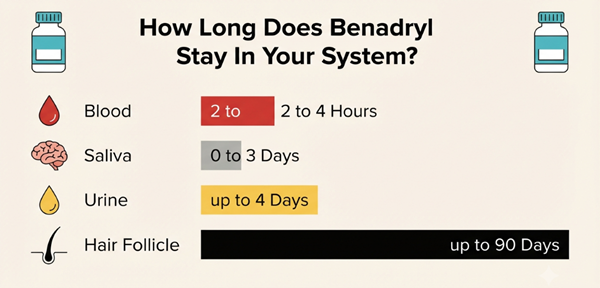
How Long Does Benadryl Last in Your System on a Drug Test
Standard workplace drug panels do not typically screen for diphenhydramine, so a normal urine test will not flag Benadryl use.
That said, diphenhydramine can still be detected using more specialized testing:
- Urine: up to 2 to 4 days after the last dose
- Blood: up to 1 to 2 days after the last dose
- Saliva: up to 1 to 2 days after the last dose
One important caveat worth knowing is that Benadryl has been known to cause false positives for other substances on certain drug screens, including methadone and PCP, which is why confirmation testing matters if a result seems unexpected.
If Benadryl dependence is affecting daily life, call Palm Coast Treatment Solutions to discuss treatment options.
What Benadryl Misuse Does to the Body
Taking Benadryl outside of the recommended dose does more than make you drowsy. It puts real strain on your heart, brain, and nervous system.
At higher doses, people sometimes chase a euphoric or dreamlike feeling, occasionally paired with visual hallucinations. This is not a safe or reliable high. It is closer to a toxic reaction.
Signs of an overdose or dangerous misuse pattern include:
- Rapid or irregular heartbeat
- Extreme drowsiness that is hard to wake from
- Dilated pupils and blurred vision
- Confusion, agitation, or hallucinations
- Dry mouth, flushed skin, and urinary retention
- Seizures in severe cases
Some of these effects reverse once the drug clears your system. Others, particularly with long-term heavy use in older adults, have been linked in research to lasting cognitive changes. That distinction matters, and it is part of why misuse should never be brushed off as harmless just because Benadryl is sold over the counter.
Recovery Timeline After Stopping Regular Benadryl Use
Most people who stop occasional Benadryl use feel back to normal within a day or two, once the drug fully clears the body.
For someone who has been using it frequently, in high doses, or as a sleep aid every night for weeks or months, stopping can bring on a different experience:
- First 24 to 48 hours: rebound insomnia, anxiety, and irritability as the body adjusts
- Days 2 to 5: peak withdrawal discomfort, including restlessness and difficulty sleeping
- Weeks 1 to 2: symptoms gradually ease as sleep patterns start to normalize
- Beyond 2 weeks: most physical symptoms resolve, though psychological dependence on the sleep aid effect can take longer to unwind
This timeline varies from person to person, and it looks very different for someone using Benadryl alongside other substances. If your loved one has been combining it with alcohol, opioids, or anxiety medication, professional support during withdrawal is strongly recommended rather than optional.
Expert’s Advice: Avoid combining Benadryl with alcohol or sedatives without medical guidance for safety.

Getting Help After Learning How Long Benadryl Lasts
If you have made it this far because Benadryl has quietly become something you or your loved one cannot function without, please know this pattern is more common than most families realize, and it is treatable.
At Palm Coast Treatment Solutions, we work with individuals whose relationship with over-the-counter and prescription medications has grown beyond what feels manageable. Our team understands that dependence on something as ordinary as an allergy pill can still carry real physical and emotional weight.
Depending on your situation, our clinical team may recommend the following:
- Prescription Drug Addiction Rehab for structured, medically informed care around medication dependence
- Dual Diagnosis Treatment if anxiety, insomnia, or another mental health condition is driving the reliance on Benadryl
- Intensive Outpatient Program (IOP) for flexible, ongoing support that fits around daily life
- Family Therapy to help loved ones understand what is happening and how to support recovery without enabling it
We are accredited by The Joint Commission, licensed by the Florida Association of Recovery Residences, and recognized by the National Association of Addiction Treatment Providers. Every treatment plan is built around your specific history, not a one-size-fits-all script.
You do not have to figure this out alone. Call us at (386) 284-4151 or reach out through our contact page to speak with someone who understands, confidentially and without judgment.
FAQs
Q: How long does Benadryl last before it wears off?
Most people experience the noticeable effects of a standard Benadryl dose for about 4 to 6 hours. However, drowsiness, slowed reaction time, or grogginess may last longer, especially after higher doses, nighttime use, or in older adults who metabolize the medication more slowly.
Q: How long does Benadryl last in your system after one pill?
Although the sedative effects usually wear off within several hours, a single dose of Benadryl can remain in your body for approximately 24 to 48 hours. Factors such as age, liver function, metabolism, and dosage can affect how quickly the medication is eliminated.
Q: How long does Benadryl last in the body for older adults?
Older adults often process Benadryl more slowly because of age-related changes in liver and kidney function. As a result, drowsiness, confusion, and detectable drug levels may last longer than they do in younger adults, increasing the risk of falls and other side effects.
Q: What is Benadryl used for besides allergies?
In addition to treating allergy symptoms, Benadryl is commonly used for hives, itching, motion sickness, cold symptoms, and occasional insomnia because of its sedating effects. However, it is generally not recommended as a long-term sleep aid due to potential side effects and tolerance.
Q: How long does Benadryl last when you take it every night?
The medication still remains active for several hours after each dose, but regular nightly use often leads to tolerance, making its sedative effects less noticeable over time. Because of potential health risks, Benadryl is not recommended as a long-term solution for sleep problems.
Q: Can Benadryl show up on a standard drug test?
No. Standard workplace drug tests do not typically screen for diphenhydramine, the active ingredient in Benadryl. However, specialized toxicology testing can detect the medication in blood, urine, or saliva for one to several days after it has been taken.
Q: How long does Benadryl last after taking a double dose?
Taking more than the recommended dose can prolong both the medication’s effects and the time it remains in your body. Higher doses also increase the risk of excessive drowsiness, confusion, blurred vision, rapid heartbeat, and other potentially serious side effects requiring medical attention.
Q: Is it dangerous to take Benadryl every day?
Daily Benadryl use, particularly over long periods or at higher doses, may increase the risk of tolerance, falls, confusion, memory problems, and other side effects. Older adults are especially vulnerable. Talk with a healthcare provider before using Benadryl regularly for any reason.
Q: What does Benadryl withdrawal feel like?
People who stop frequent or high-dose Benadryl use may experience rebound insomnia, anxiety, irritability, restlessness, and difficulty sleeping for several days or longer. While symptoms are usually temporary, medical guidance can help if withdrawal becomes severe or difficult to manage.
Q: How long does Benadryl last when mixed with alcohol?
Combining Benadryl with alcohol can intensify sedation and slow how quickly the body processes both substances. This combination increases the risk of extreme drowsiness, impaired coordination, slowed breathing, accidents, and other potentially dangerous complications that require immediate medical attention if severe.
Q: Can you build a tolerance to Benadryl?
Yes. Regular Benadryl use can lead to tolerance within days or weeks, meaning higher doses may be needed to produce the same sedative effect. Increasing the dose raises the risk of side effects and potential misuse without improving the medication’s long-term effectiveness.
Q: When should someone seek help for Benadryl misuse?
If someone regularly takes Benadryl in larger doses, uses it for reasons other than its intended purpose, or relies on it to cope with sleep, anxiety, or emotional distress, it’s important to seek professional evaluation and discuss safer, evidence-based treatment options.
References
- National Library of Medicine, MedlinePlus: Diphenhydramine
- NCBI StatPearls: Diphenhydramine
- Cleveland Clinic: Diphenhydramine (Benadryl)
- Mayo Clinic: Diphenhydramine (Oral Route)
- FDA: Benadryl Drug Label Information
- American Association of Poison Control Centers, National Poison Data System
- National Institute on Drug Abuse (NIDA)
- Palm Coast Treatment Solutions: Prescription Drug Addiction Rehab
- Palm Coast Treatment Solutions: Dual Diagnosis Treatment
This article is for informational purposes only and is not a substitute for professional medical advice. If you or a loved one needs support, Palm Coast Treatment Solutions is available to help.