You are either pregnant or considering getting pregnant and you likely have some questions about drinking alcohol. Perhaps you think it is fine to have some. Perhaps you were drinking before you realized that you were pregnant and are concerned. Or you may be worried about someone else’s pregnancy. It is essential to realize there is no safe level of alcohol use during pregnancy. Not a single drink. Not one sip. Not a ‘special occasion’ exception.
Any amount of alcohol can potentially harm a developing baby. Knowing how much will increase that riskn and what kind of harm it can cause helps you make informed decisions on your health and your baby’s health. Let’s take a look at the research findings.
What are Fetal Alcohol Syndrome and FASD?
The most serious form of fetal alcohol spectrum disorder is Fetal Alcohol Syndrome (FAS).
Fetal Alcohol Spectrum Disorders (FASDs) are an umbrella term that describes a range of disorders that result from prenatal alcohol exposure. These include:
- Fetal Alcohol Syndrome (FAS): The most severe type. Babies with FAS have distinctive facial features, poor growth, and brain/nervous system problems. The facial features include small eyes, a thin upper lip, and a smooth ridge between the nose and upper lip (called the philtrum). Children with FAS may have small heads, low birth weight, and problems with hearts, bones, or kidneys. Learning disabilities and behavioral problems are common.
- Partial Fetal Alcohol Syndrome (pFAS): Like FAS but with some but not all of the features. The child has been exposed to alcohol and has some characteristics of FAS.
- Alcohol-Related Neurodevelopmental Disorder (ARND): The child has brain and nervous system damage without the facial features of FAS. Problems include poor memory, difficulty concentrating, poor judgment, hyperactivity, and difficulty learning.
- Alcohol-Related Birth Defects (ARBD): Problems with the heart, kidneys, bones, hearing, or vision caused by prenatal alcohol exposure.
- Neurobehavioral Disorder Associated with Prenatal Alcohol Exposure (ND-PAE): Problems with thinking, memory, behavior, and day-to-day functioning without facial features.
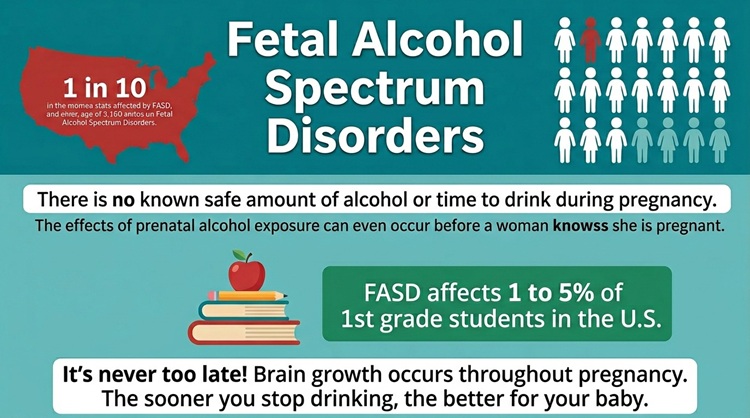
The important thing to understand is that FASDs aren’t rare. An estimated 1 to 5 percent of U.S. first-graders have FASD. That’s millions of children. Many are undiagnosed because the effects aren’t always obvious at birth.
How Much Drinking Causes Fetal Alcohol Syndrome
There is no known safe amount of alcohol during pregnancy.
Major health organizations including the U.S. Surgeon General, the American Academy of Pediatrics, the CDC, and the National Institute on Alcohol Abuse and Alcoholism (NIAAA) all state the same thing: no amount of alcohol is safe during pregnancy.
Alcohol crosses the placenta and directly affects the developing fetus. Alcohol is a teratogen, which means it can cause birth defects. It interferes with brain development, organ development, and normal growth. The fetus’s developing brain is especially vulnerable because the brain develops throughout the entire pregnancy.
“No amount of alcohol consumption is safe during pregnancy. Alcohol can affect fetal development at any stage of pregnancy, and different aspects of the child are developing at all stages.” – CDC
100% Confidential Support is Available 24/7
No matter what you’re going through, you’re not alone. Our dedicated team is here to provide a safe, judgment-free space where you can talk openly and honestly. Whether you need emotional support, resources, or just someone to listen.
We’re here for you—completely confidential and always respectful of your privacy. Call us today!
What Does Heavy Drinking Actually Do?
While no amount is safe, heavy drinking carries the greatest risk for the most severe problems.
Heavy drinking during pregnancy is typically defined as repeatedly drinking more than five units of alcohol per day (roughly two large glasses of wine), or binge drinking (four or more drinks in one sitting). Heavy drinking carries the highest risk for Fetal Alcohol Syndrome (FAS), the most severe form of fetal alcohol spectrum disorders.
According to the CDC, for a diagnosis of neurobehavioral disorder associated with prenatal alcohol exposure (ND-PAE), the mother must have consumed more than minimal levels of alcohol before the child’s birth, defined as more than 13 alcoholic drinks per month of pregnancy or more than 2 alcoholic drinks in one sitting.
But here’s the critical point: this doesn’t mean 13 drinks per month is a safe threshold. It just means this is the level at which doctors can diagnose certain conditions. People exposed to much less can still be affected.
Contact Palm Coast Treatment Solutions
Battling with Drug and Alcohol Addition? Remember, you are not alone and we are here to help you!
Understanding the Risk of Heavy Drinking
Several factors influence whether prenatal alcohol exposure causes problems.
How Much You Drink: More alcohol generally means greater risk. But even light drinking can cause issues for some babies.
How Often You Drink: Drinking daily is worse than occasional drinking. But binge drinking (multiple drinks at once) is also particularly harmful because it exposes the baby to high levels of alcohol at once.
When You Drink: Alcohol can cause harm at any stage of pregnancy. First trimester drinking risks affecting facial development and brain structure. Second and third trimester drinking risks affecting brain growth and organ development. Since women often don’t know they’re pregnant until 4-6 weeks, damage can occur before anyone realizes there’s a pregnancy.
Your Individual Factors: Genetics, overall health, nutrition, stress, and other factors influence your individual risk. Some women who drink might have a baby with no obvious problems. Others who drink less might have a baby affected. This unpredictability is exactly why experts say no amount is safe.
Age and Health Status: Younger women and women in better health might tolerate alcohol differently than older women or those with existing health conditions. But this doesn’t make any amount safe.
Overcome Addiction with Palm Coast Treatment Solutions.
Book an appointment.
The Actual Effects: Why This Matters
Understanding what alcohol does to a developing baby helps explain why the message is so firm.
Alcohol interferes with brain development. It disrupts the formation of brain cells, the connections between brain cells, and the chemicals that regulate brain function. The developing fetal brain is exquisitely vulnerable because it’s developing rapidly throughout pregnancy, with different brain regions developing at different times. Alcohol exposure can disrupt development based on when the exposure happens.
Physical effects include poor growth (low birth weight and short height), distinctive facial features, and problems with organs. Children with FASD often have heart problems, kidney problems, bone problems, vision problems, or hearing loss. These are lifelong issues requiring ongoing medical care.
Behavioral and learning effects include intellectual disability, learning disabilities, attention problems, poor memory, difficulty with math, poor judgment, hyperactivity, and behavioral problems. Many children with FASD are misdiagnosed with ADHD or conduct disorder because the symptoms overlap. The difference is that FASD is preventable and ADHD/conduct disorder are not caused by parental drinking.
What About Light or Occasional Drinking?
Some studies looked at children whose mothers drank light amounts, maybe one or two drinks per week and found no major concerns. This has led some people to think light drinking during pregnancy is probably okay.
But here’s the issue: these studies involved small numbers of children. Even if no problems were seen, that doesn’t prove no problems occurred. It just means the sample was too small to detect problems if they were there. A woman who drank lightly and had a healthy baby didn’t have scientific proof that light drinking is safe, she just got lucky.
Other research has found that even light alcohol exposure can increase the risk of certain problems, including lower birth weight, miscarriage, and learning difficulties.
Overcome Addiction with Palm Coast Treatment Solutions.
Book an appointment.
Different Amounts of Drinking and its Risks
Here’s what different levels of drinking have been associated with:
Drinking Level | Per Month | Per Week | Known Associated Risks | Severity |
No drinking | 0 drinks | 0 drinks | No FASD | N/A |
Very light | 0-3 drinks | 0-1 drink | Possibly minimal, but unclear | Unclear |
Light | 4-12 drinks | 1-3 drinks | Some studies suggest possible effects on learning | Low to moderate |
Moderate | 13+ drinks | 3+ drinks | Increased behavioral and learning problems | Moderate |
Heavy | 13+ drinks/month or binge | 2+ per sitting | Increased risk of FAS and severe FASD | High |
Very heavy | 20+ drinks/month or frequent binge | Multiple per sitting | High risk of severe FAS | Very high |
Remember: this table shows what research has found, not safety thresholds. “No known risk at this level” does not mean “safe at this level.” It just means doctors haven’t documented problems at that level in the studies done.
What If You Already Drank During Pregnancy?
If you’ve already consumed alcohol during pregnancy, it’s important to know: it’s never too late to stop.
The brain develops throughout pregnancy, and brain growth continues even right up until delivery. Stopping alcohol consumption as soon as possible gives your baby the best chance of avoiding severe damage.
Many women drink before realizing they’re pregnant. This is common because it takes 4 to 6 weeks to realize you’re pregnant, and a lot of development happens in those early weeks. If this happened to you:
- Don’t panic. One or two drinks before you knew you were pregnant is unlikely to cause severe harm, especially if you stop immediately upon learning you’re pregnant.
- Do tell your healthcare provider. They need to know about the timing and amount of any alcohol exposure so they can monitor the pregnancy appropriately.
- Do stop drinking immediately. Every day you don’t drink from this point on improves the odds for your baby.
- Do attend all prenatal appointments and follow medical advice. Good prenatal care helps catch any problems early.
The key is stopping as soon as you know you’re pregnant. Brain growth continues throughout pregnancy, so stopping early limits damage.
Overcome Addiction with Palm Coast Treatment Solutions.
Book an appointment.
Prevention Of Fetal Alcohol Syndrome
The only way to guarantee your baby won’t have FASD is to not drink alcohol during pregnancy.
This means:
- If you’re pregnant: Don’t drink. Not even wine (which many think is safer—it’s not). Not beer. Not hard liquor. Not mixed drinks. Not those “pregnancy-safe cocktails” some restaurants offer no cocktails that are pregnancy-safe. Nothing.
- If you might be pregnant: Don’t drink. It takes 4-6 weeks to get a positive pregnancy test. If you’re sexually active and not using reliable birth control, you could be pregnant already without knowing.
- If you’re trying to get pregnant: Don’t drink. This gives you time to establish the habit of not drinking before pregnancy and eliminates the risk of drinking before you know you’re pregnant.
- If you’re breastfeeding: Be cautious. Some alcohol passes into breast milk. While occasional light drinking might be acceptable (talk to your doctor), regular drinking should be avoided.

Getting Help if You Struggle With Alcohol
If you’re pregnant or thinking about becoming pregnant, and you struggle with alcohol use, help is available and essential.
Palm Coast Treatment Solutions in Palm Coast, Florida, offers comprehensive alcohol addiction treatment. If you’re pregnant and struggling with alcohol, treatment is safe and necessary for your health and your baby’s health.
Our services include:
- Addiction Assessment and Treatment tailored to pregnant women
- Medically Supervised Detoxification safe during pregnancy
- Individual Counseling addressing alcohol dependence
- Group Support connecting with other women in recovery
- Prenatal Care Coordination working with OB/GYN providers
- Medication-Assisted Treatment safe options for pregnancy
- Mental Health Support addressing underlying issues
- Family Involvement building support systems
Getting help during pregnancy is one of the most important things you can do for your baby. Treatment is available, effective, and can prevent FASD entirely.
Call us at (386) 284-4151 or visit our contact page to discuss your situation confidentially. We understand the complexity and don’t judge. Our team is available 24/7 to help.
FAQs
If I Drank Before I Knew I Was Pregnant, Would My Baby Be Okay?
In many cases, drinking before knowing you are pregnant does not result in serious harm, especially if alcohol use stops immediately. The most important step is to avoid further alcohol consumption and attend regular prenatal appointments so your healthcare provider can monitor your pregnancy and development.
Is There a Safe Amount I Can Drink During Pregnancy?
No. Major health organizations advise that there is no known safe amount of alcohol during pregnancy. Because alcohol can affect fetal development at any stage, the safest choice is complete abstinence throughout pregnancy to minimize potential risks to the developing baby.
Is Wine Safer Than Liquor?
No. Wine, beer, liquor, and other alcoholic beverages all contain alcohol, which can affect fetal development. The type of drink does not eliminate the risk. During pregnancy, avoiding all alcoholic beverages is recommended to provide the safest environment for healthy development.
What If I Drank Heavily Early in Pregnancy but Stop Now?
Stopping alcohol use now is one of the most important actions you can take. Fetal development continues throughout pregnancy, particularly brain development. Inform your healthcare provider about your alcohol use history so they can provide guidance, monitor progress, and support a healthy pregnancy moving forward.
Can My Partner’s Drinking Affect My Baby?
A partner’s alcohol consumption does not directly expose the developing baby to alcohol. However, a supportive environment can make it easier to avoid alcohol during pregnancy and maintain healthy habits. Emotional support, healthy communication, and shared commitment to wellbeing can benefit both parent and child.
What Are the Long-Term Effects of FASD?
Fetal Alcohol Spectrum Disorders (FASD) can cause lifelong challenges involving learning, memory, attention, behavior, emotional regulation, and social functioning. Severity varies among individuals. Early diagnosis, educational support, therapy, and appropriate interventions can help improve outcomes and quality of life for affected individuals.
How Can I Tell if My Baby Has Fetal Alcohol Syndrome?
Some signs may be noticeable at birth, while others emerge as a child grows and develops. Symptoms can include growth concerns, developmental delays, learning difficulties, and behavioral challenges. A qualified healthcare professional can evaluate medical history, development, and physical findings to determine an accurate diagnosis.
Is It Too Late to Prevent FASD if I’m Already Months Into Pregnancy?
No. It is never too late to stop drinking during pregnancy. Because fetal brain and body development continue throughout pregnancy, avoiding alcohol from this point forward can help reduce additional risks and support healthier development for the remainder of the pregnancy.
What If I Struggle With Alcohol Dependence?
Professional help is available for pregnant individuals experiencing alcohol dependence. Healthcare providers can recommend safe treatment options, medical supervision, counseling, and recovery support. Seeking treatment can protect both maternal health and fetal development while providing the resources needed to achieve and maintain sobriety.
Can I Have Any Alcohol While Breastfeeding?
Small amounts of alcohol can pass into breast milk. Recommendations may vary depending on individual circumstances, drinking patterns, and infant age. Consulting your healthcare provider is the best way to receive personalized guidance regarding alcohol use while breastfeeding and protecting your baby’s health.
Why Do Some Women Drink During Pregnancy and Have Healthy Babies?
Individual pregnancies vary, and not every baby exposed to alcohol experiences noticeable effects. However, there is no reliable way to predict how alcohol will affect a developing fetus. Because risk cannot be accurately determined in advance, healthcare professionals recommend avoiding alcohol throughout pregnancy.
References
- CDC, “About Fetal Alcohol Spectrum Disorders (FASDs)”
- Cleveland Clinic, “Fetal Alcohol Syndrome”
- Medical News Today, “How Much Drinking Causes Fetal Alcohol Syndrome?”
- Nemours KidsHealth, “Fetal Alcohol Syndrome (FAS)”
- American Academy of Pediatrics, “Fetal Alcohol Spectrum Disorders: Parent FAQs”
- NIAAA, “Understanding Fetal Alcohol Spectrum Disorders”
- Medicines in Pregnancy, “Alcohol”
- Wikipedia, “Fetal Alcohol Spectrum Disorder”
- Healthy Acadia, “Understanding Fetal Alcohol Spectrum Disorders”
- NCBI StatPearls, “Fetal Alcohol Syndrome”