You are familiar with a person like this. Perhaps it’s a relative. Perhaps someone from your past. He or she is the one who attempts something and can’t seem to quit. Not because they’re trying to quit, but because there’s nowhere else to go when everything is going wrong in their life. Alcohol for one month. Six months later, it’s all about gambling. Then it’s back to the drugs. There seems to be an addiction to addiction.
Their parents tell you such things as “They’ve always been this way” or “There’s a history of addiction in our family. And you think: Is there anyone who is predestined to suffer with this? But does an addictive personality really exist?
There is no easy answer. It’s not one thing. But decades of research show that some individuals have a personality that makes them a lot more likely to become addicted. Some of these are characteristics that are innate. Others are influenced by experiences and trauma. But what matters most is that when you know these traits, you’ll be better able to realize if somebody needs help before the addiction gets too bad.
What is an Addictive Personality?
Addictive personality is a group of personality traits that are seen in individuals who develop addictive behaviors. It’s sort of a universal system. If you notice a combination of these characteristics in an individual, he or she may be at risk for substance abuse and/or behavioral addictions, such as gambling and/or compulsive shopping.
Having these traits doesn’t guarantee addiction will happen. Not even close. Plenty of people have strong impulsive streaks or sensation-seeking tendencies and never develop addiction. But when you combine multiple risk traits together, add in some stress and some trauma or difficult life circumstances, and make sure there’s access to addictive substances, then you’ve got a concerning situation.
Signs of An Addictive Personality
If you’ve studied addiction at all, you know that certain personality traits show up again and again in people who struggle with it. Here are the biggest ones.
Impulsivity – These are the people who don’t think before they act, especially when emotions are running high. They see something they want and they take it. They feel something uncomfortable and they find a quick way to escape it. No pause. No “what happens if.” Just action. Sometimes that action is substance use. Sometimes it’s reckless spending or risky sexual behavior. The problem is that the impulsive brain doesn’t naturally ask “what are the consequences?” Scientists know this is partly hardwired into someone’s DNA, but it’s also shaped by how their brain develops (the part that controls impulse doesn’t fully mature until around age 25) and by what they learned growing up.
Compulsiveness – It’s when someone gets into a pattern of repeating the same behavior over and over to feel better temporarily. Someone might always drink when they’re stressed. Someone else might gamble every time they feel anxious. Another person might go on shopping sprees when they’re depressed. At the moment, it works. The stress goes away. The anxiety quiets down. But then it comes back, so they repeat the behavior again. And again. Until doing it isn’t even about feeling good anymore. It’s about not feeling bad.
Sensation-seeking – These people get bored easily. They need excitement. They’re the ones skydiving, rock climbing, and taking extreme risks. They chase intensity and novelty. When you add drugs or alcohol to someone like this, the high is compelling because it delivers exactly what they’re looking for: intense sensation and excitement. It’s a powerful combination.
Low self-esteem – Might seem obvious, but it’s significant. People who don’t like themselves, who think they’re worthless or undeserving, use substances to escape how they feel about themselves. Drugs and alcohol make them feel less bad about who they are, even if it’s temporary. That temporary relief is addictive in itself.
Poor emotional regulation – It means someone struggles to manage their feelings. Maybe they feel everything intensely. Maybe small disappointments feel catastrophic. Maybe they can’t calm themselves down when they’re angry. They might use substances because it’s the fastest way they know to change how they feel. It’s like an emotional emergency button.
Genetic predisposition – Is important to mention because roughly 40 to 60 percent of addiction risk is inherited. If your parents or grandparents struggled with addiction, you’re at higher risk. Not because of parenting, but because you inherited genes that affect how your brain processes reward and how much impulse control you naturally have. It’s not fair, but it’s real.
100% Confidential Support is Available 24/7
No matter what you’re going through, you’re not alone. Our dedicated team is here to provide a safe, judgment-free space where you can talk openly and honestly. Whether you need emotional support, resources, or just someone to listen.
We’re here for you—completely confidential and always respectful of your privacy. Call us today!
Additional Risk Factors Beyond Personality
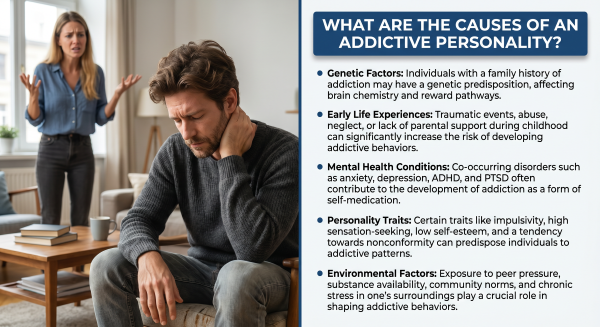
- Mental health conditions dramatically increase addiction vulnerability. About 50 percent of those with personality disorders are diagnosed with substance addiction. People with anxiety disorders often use alcohol to self-medicate. People with depression use substances seeking relief or escape. People with ADHD might misuse stimulants. People with trauma histories are particularly vulnerable.
- Environmental factors matter profoundly. Growing up in homes where substance use was normalized increases risk. Early exposure to drugs or alcohol raises addiction likelihood. Trauma, physical abuse, sexual abuse, neglect, and witnessing violence strongly predict later addiction. Peer groups matter too; adolescents surrounded by substance-using peers are at higher risk.
- Stress and adversity activate addiction vulnerability. Chronic stress, major losses, financial problems, or relationship crises can trigger addiction in people with predisposing traits. The substance provides escape or temporary relief from overwhelming circumstances.
- Access and opportunity matter. Someone with addictive traits but no access to substances has lower addiction risk than someone with the same traits plus easy access.
Contact Palm Coast Treatment Solutions
Battling with Drug and Alcohol Addition? Remember, you are not alone and we are here to help you!
Addictive Personality Traits vs. Addiction Disorder
It’s crucial to understand the distinction:
Factor | Addictive Personality Traits | Addiction Disorder |
Definition | Personality characteristics increasing addiction risk | Medical condition involving compulsive substance use despite harm |
Diagnosis | Not a formal diagnosis in DSM-5 | Formal medical diagnosis |
Presence | Can exist without developing addiction | Requires actual addiction behavior |
Examples | Impulsivity, sensation-seeking, low self-esteem | Substance use disorder, behavioral addiction |
Treatability | Can be addressed through therapy, awareness, healthy coping | Requires professional treatment |
Prognosis | Having traits doesn’t guarantee addiction | Requires intervention for recovery |
Prevalence | Common trait combinations | Affects millions with proper diagnosis |
Overcome Addiction with Palm Coast Treatment Solutions.
Book an appointment.
Signs of an Emerging Addictive Personality Pattern
If you’re noticing patterns in yourself or someone you care about, these signs warrant attention:
- Acting on impulses without considering consequences
- Difficulty controlling behavior even when you want to
- Seeking constant stimulation or becoming easily bored
- Using substances or behaviors to manage emotions
- Feeling compelled to repeat behaviors despite negative outcomes
- Lying about or minimizing the extent of use
- Neglecting responsibilities, hobbies, or relationships to engage in the behavior
- Continuing despite knowing it’s harmful
- Personality changes like increased aggression, irritability, or depression
- Loss of interest in previously enjoyed activities
- Obsessing over a particular substance or activity at the expense of other responsibilities
- Difficulty saying no or setting limits
- Needing more of the substance or behavior to achieve the same effect (tolerance building)
What Can You Do to Prevent an Addiction Personality
If you recognize addictive personality traits in yourself or someone you care about, action now can prevent serious addiction.
For yourself:
- Develop awareness of your personal addiction vulnerabilities
- Build healthy coping mechanisms for stress and emotions (exercise, therapy, social connection, creative outlets)
- Avoid or limit exposure to substances and behaviors you’re vulnerable to
- Seek therapy, especially if you have trauma or mental health conditions
- Build a strong support network of healthy people
- Manage stress proactively rather than reactively
- Consider therapy even before addiction develops. Preventive mental health care is powerful
For loved ones:
- Have conversations without judgment. Avoid blame or criticism.
- Share specific observations: “I’ve noticed you seem to use alcohol whenever you’re stressed”
- Express concern from a place of love: “I care about you and I’m worried”
- Don’t enable addictive behavior by covering up consequences
- Suggest professional help: “I think therapy could really help you work through this”
- Consider family therapy if addiction is already present
- Set boundaries about what you will and won’t tolerate
- Take care of your own mental health, supporting someone struggling is emotionally taxing

Overcome Addiction with Palm Coast Treatment Solutions.
Book an appointment.
Getting Help at Palm Coast Treatment Solutions
If you or a loved one shows signs of an addictive personality or is already struggling with addiction, professional treatment is essential.
Palm Coast Treatment Solutions offers comprehensive addiction treatment addressing both the addiction itself and the underlying personality traits, mental health conditions, and trauma that contribute to it.
Our services include:
- Behavioral Addiction Assessment identifying your specific risk factors
- Individual Therapy addressing underlying issues
- Cognitive Behavioral Therapy (CBT): changing thought patterns and behaviors
- Dialectical Behavior Therapy (DBT) for emotion regulation and distress tolerance
- Group Therapy for peer support
- Dual Diagnosis Treatment addressing mental health alongside addiction
- Family Therapy involving loved ones in recovery
- Intensive Outpatient Programs for flexible, structured care
- Residential Treatment when intensive support is needed
We understand that addiction develops from complex interactions between personality, brain chemistry, environment, and trauma. We treat the whole person, not just the addiction.
If you’re concerned about addictive personality traits, in yourself or someone you care about, don’t wait for full addiction to develop. Early intervention is powerful. Call us at (386) 284-4151 or visit our contact page to discuss your situation. Our team is available 24/7, and all conversations are completely confidential.
FAQs
Q: Is an addictive personality a real diagnosis?
No, “addictive personality” is not a formal diagnosis in the DSM-5. It’s a casual term describing personality traits that increase addiction risk. However, the traits themselves are real and measurable, even if the term is informal.
Q: Can you have an addictive personality without becoming addicted?
Absolutely. Having personality traits that increase addiction risk doesn’t guarantee addiction. Many people with impulsivity, sensation-seeking, and low self-esteem never develop addiction. Traits are risk factors, not destiny.
Q: Is addiction a personality trait or a disease?
Addiction is a disease, a complex condition affecting brain chemistry, behavior, and decision-making. While personality traits increase risk, addiction involves actual changes to how the brain functions. It’s not simply “who someone is.”
Q: Can an addictive personality be changed?
Yes. Personality traits can be modified through therapy, conscious effort, and behavioral change. Impulsivity can be managed. Self-esteem can be built. Emotion regulation can be learned. People can change.
Q: If my parents had an addiction, would I definitely become addicted?
No. Having a parent with addiction increases your genetic risk, but it’s not deterministic. Environmental factors, choices, stress management, and support systems all influence whether you develop addiction. Knowing your family history lets you take preventive action.
Q: How can I tell if I have an addictive personality?
If you notice yourself being impulsive, struggling with emotional regulation, seeking constant stimulation, using substances to manage emotions, or repeating behaviors despite negative consequences, these might indicate addictive personality traits. A mental health professional can provide an assessment.
Q: What’s the difference between being adventurous and having an addictive personality?
Adventurous people seek new experiences within reasonable risk boundaries and maintain balance with other life areas. People with strong addictive traits seek increasingly intense experiences, often neglecting other responsibilities and engaging in dangerous behaviors.
Q: Can therapy help prevent addiction if I have risk factors?
Absolutely. Therapy helps build coping skills, address trauma, treat mental health conditions, and develop healthier patterns. Preventive mental health care is one of the best addiction prevention strategies.
Q: If I struggle with addiction, is it because of my personality?
Addiction results from multiple factors: genetics, environment, trauma, brain chemistry, opportunity, and yes, personality traits. It’s not your fault, but recovery is your responsibility. Professional help makes recovery much more achievable.
Q: How can I support someone showing addictive personality traits?
Express concern without judgment. Encourage professional help. Set healthy boundaries. Don’t enable harmful behavior. Take care of your own mental health. Model healthy coping strategies. Include them in supportive community activities.
Q: Is it too late to get help if addiction has already developed?
Never too late. Even long-term addiction can be treated successfully. The longer it persists, the more intensive treatment might need to be, but recovery is possible at any stage.
Overcome Addiction with Palm Coast Treatment Solutions.
Book an appointment.
References
- Addiction Center, “Addictive Personality Traits and Risk Factors”
- Better Help, “Addictive Personality Signs and Characteristics”
- Good Health Psych, “Addictive Personality Disorder: Causes and Risk Factors”
- Mayo Clinic Health System, “Addictive Personality Traits”
- Mental Health Center of San Diego, “Addictive Personality Traits: Signs and Insights”
- St. Joseph Institute for Addiction, “6 Personality Traits Linked to Addiction”
- Addiction Help, “What is an Addictive Personality?”
- American Addiction Centers, “Traits of an Addictive Personality”
This content is for informational purposes only and does not constitute medical advice or a clinical recommendation. For a personalized assessment, please consult a licensed mental health professional. To learn more about evidence-based mental health and addiction treatment in Florida, call (386) 284-4151.